



Its a big story whenever metal detectorists uncover a valuable archaeological treasure—not just an interesting trinket here or there, but an actual cache of precious items that reveal the presence of ancient civilizations from centuries or millennia ago. This doesn’t happen all that often, which is why these discoveries garner so much attention. But within just a few weeks’ time, two incredibly rich collections of ancient artifacts have been discovered by detectorists in Romania, highlighting the activities of not just one but the two ancient cultures (the Dacians and the Romans) that ruled the territory in succession between 2,500 and 1,700 years ago.
Hitting the Motherlode: Elite Dacian Silver Hoard Found in Central Romania
In early April, near the commune of Breaza in Mureș County in the central part of Romania, two amateur metal detectorists, Dionisie-Aurel Moldovan and Sebastian-Adrian Zăhan, unearthed a stunningly valuable cache of silver artifacts that have been linked to the Dacian culture. This is the first clear evidence of Dacian habitation in this area, revealing the influence of a prosperous culture that dominated the lands of modern-day Romania in the latter stages of the first millennium BC up through the end of the first century AD.
Now held by the Museum of Mureș County, the treasure includes six finely crafted silver objects: a wide bracelet with a plant-inspired design, three brooches known as fibulae, a neck chain with nail-shaped pendants, and a belt composed of alternating oval and ring plates, highlighted by a rectangular plaque with sun motifs. The collection weighs around 550 grams and is believed to have belonged to an elite member of Dacian society, likely an aristocrat.
- The Wolves of Dacia Take On the Roman Empire
- Romanian Archaeologists Unearth Gold-Filled Grave from 4,500 BC
Among the pieces, the bracelet is especially noteworthy. Its flared ends are delicately embellished with plant motifs, a signature of Dacian artistry. Two of the fibulae are long and simple, each with a diamond-shaped plate, while the third is smaller and features four rounded knobs. The chain ends in a loop, suspending three tiny nail-shaped pendants that suggest a ceremonial function. The belt’s design, particularly the solar imagery on the central plaque, points to the symbolic significance of the sun in the Dacian spiritual belief system.
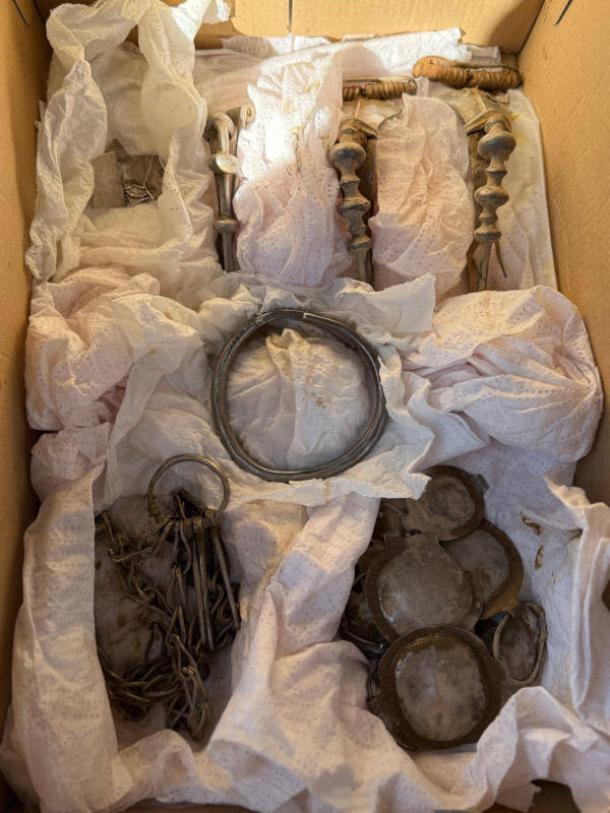
Collection of silver artifacts recovered by detectorists Dionisie-Aurel Moldovan and Sebastian-Adrian Zăhan, shortly after being removed from the ground. (Breaza Mures Municipality City Hall/Facebook).
The purpose behind this hidden treasure remains a mystery. Was it buried as an offering to a god, or to protect it from thieves or marauders? While there is no clear answer at this point, historians note that such burials were typical in antiquity, reflecting both sacrificial practices and the pillaging and plundering that was common in the ancient world.
What makes this find especially significant is that no previous Dacian settlement had been identified in the Breaza area. This discovery not only confirms their presence but also offers new insights into the cultural and social fabric of ancient Dacia, a territory that roughly corresponds to today’s Romania and Moldova.
Authorities verified that Moldovan and Zăhan followed all legal procedures when reporting the find. The silver objects have been cataloged and will undergo further study before being showcased at upcoming exhibits at the Mureș County Museum.
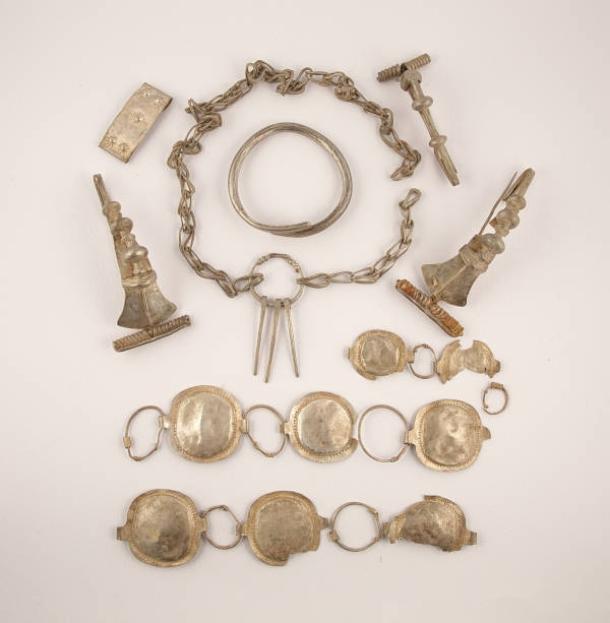
Polished silver hoard recovered near Breaza in Mureș County, Romania. (Breaza Mures Municipality City Hall/Facebook).
Hitting the Jackpot: Breathtaking Roman Coin Collection Unearthed in Southern Romania
On April 19th, the Saturday before Easter, detectorist Marius “Bebe” Mangeac went out for a walk with his metal detector near the village of Letţa Veche in southern Romania, close to the Bulgarian border. He was only hoping to find an interesting item or two, but instead uncovered a massive hoard of Roman silver denarii—1,469 coins in total—dating from the mid-first to the mid-second century AD. This is now recognized as one of the largest ancient coin discoveries ever made in Romania.
- Huge Bronze Age Citadel, Three Times Larger than Troy, Found in Romania
- Massive Cache of Roman Coins and Gems Found in Ancient “Magical City”
After getting a strong hit on his detector, Mangeac started digging and just kept going, as a few coins turned into dozens and then dozens into hundreds, all of which were ancient and unfamiliar. With the assistance of other detectorists in the vicinity, he carefully collected the coins in a bag, determined not to leave any behind.
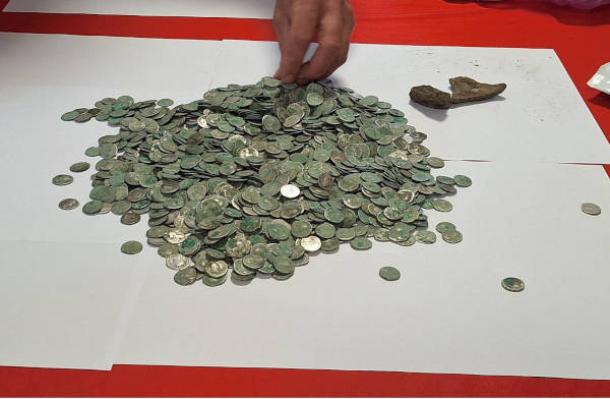
Pile of Roman coins found by Marius Mangeac, from 54 to 161 AD. (Marius Mangeac/Facebook).
Romanian law requires that archaeological finds be reported within 72 hours, and with the holiday weekend in full swing, Mangeac had little time. He spent Easter Sunday and the following Monday photographing the coins before turning them in to the City Hall of Letţa Veche. Law enforcement was present to supervise the transfer and record the exact location of the discovery, which is expected to be declared an official archaeological site and excavated professionally.
The full inventory of the coins has now been completed. The oldest coin dates back to 54 AD, to the reign of Nero, while the youngest was minted under Marcus Aurelius in 161 AD (Roman rule of the land known as Dacia lasted from 106 to 275 AD). All of the coins are silver denarii, showing significant wear from circulation. The broad span of dates suggests this was a long-term accumulation, possibly representing someone’s savings stored for safekeeping.
In addition to the coins, Mangeac also found pieces of a ceramic container, thick, curved fragments that may have come from a small amphora. It’s uncertain if the entire hoard had originally been kept in this vessel, but there’s speculation it might have been intentionally broken before burial as part of a ritual to protect the contents.
The coin hoard is set to be evaluated by the County Directorate for Culture before being handed over to the Teohari Antonescu County Museum in Giurgiu. Each piece will be analyzed for identification, age, value, and metal content. Once the assessment is complete, Mangeac will be eligible for a state reward of up to 45% of the hoard’s appraised value, a sum that is expected to be significant.
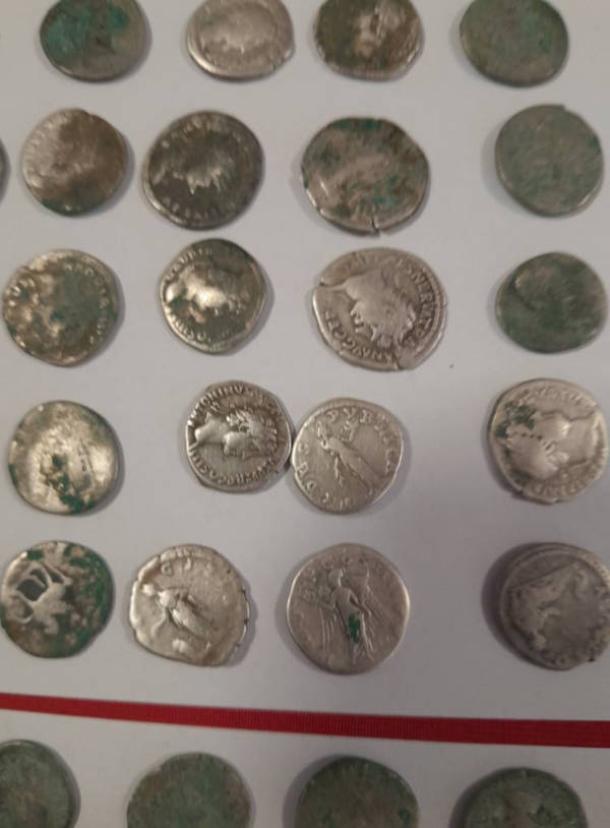
Close-up photo of several of the ancient, heavily worn Roman coin hoard from southern Romania. (Marius Mangeac/Facebook).
An Archaeological Gold Rush?
In response to the attention these two remarkable finds have generated, retailers who sell metal detecting equipment in Roman are stocking up, in anticipation of increased public demand for their products. Hoards of amateur archaeologists yielding detectors will likely be fanning out across the Romanian landscape over the next few weeks and months, seeking the hidden treasures their country apparently possesses in abundance, hidden just below the surface of the earth.
Will these efforts lead to the discovery of more ancient jackpots or motherlodes? Only time will tell—but things are definitely about to get interesting.
Top image: Roman metal detectorist Marius Mangeac stands in front of the Roman coins he discovered near the village of Letţa Veche.
Source: Marius Mangeac/Facebook.
By Nathan Falde






![The Great Pyramid Of Giza Top image: The Great Pyramid of Giza under a starlit sky, highlighting the North Face. Source: [Pixabay/Creative Commons] Image](/sites/default/files/styles/article_popular/public/field/image/Great%20Pyramid%20Of%20Giza_0.jpg?itok=EjAqNQlu)


