



A meticulously crafted cache of stone tools that were buried thousands of years ago but never used was uncovered after a chance find by a boy wandering on an Ohio golf course. Unearthed in Sugarcreek, Ohio, the collection, now known as the "Joshua Cache," contains eleven finely made stone bifaces. The tools, which have been linked to the Early Woodland Adena culture, were discovered beneath ground that had been altered by modern construction, leaving researchers with lingering questions about their true purpose and the circumstances of their burial.
The story of the Joshua Cache began in January 2021, when a young explorer named Joshua Fetter was walking near a pond on the Sugar Creek golf course. The area was undergoing grading work for future residential development. Near the water's edge, Joshua spotted a leaf-shaped stone object in the disturbed earth. Intrigued, he dug a few inches and pulled up a stone biface. He continued searching a small patch of ground and recovered eight more, unearthing an astonishing nine bifaces in an area less than one square meter.
Realizing the significance of the find, Joshua's family quickly contacted archaeologists at Kent State University. Recognizing the urgency due to the ongoing construction, researchers arrived the next morning to investigate. Within the same small patch of ground, excavation revealed two more bifaces buried roughly five centimeters below the first nine, bringing the total to eleven. The tools and associated materials were later donated to the Cleveland Museum of Natural History for permanent preservation.
The Mystery of the Unused Blades
The eleven stone tools in the Joshua Cache are lanceolate bifaces — elongated, leaf-shaped stones with flakes removed from both sides to create sharp edges. The tools display an impressive degree of precision and control, with straight, symmetrical edges and refined shaping that indicate experienced craftsmanship. Their form is consistent with the kinds of ancient technology that archaeologists associate with skilled knapping traditions across prehistoric North America.
However, microscopic examination produced one of the study's most surprising results: none of the bifaces show signs of use.
- The Great Serpent Mound of Ohio, the Largest Earthen Effigy in the World
- A Portrait of an Adena Female and Women in Adena Society
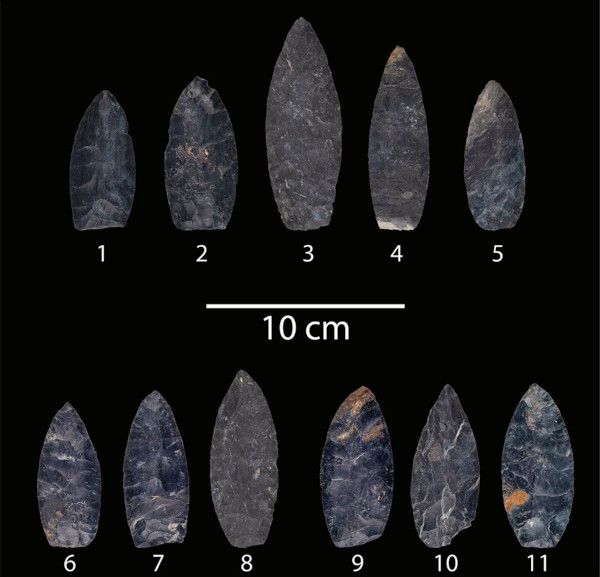
The 11 Joshua Cache bifaces recovered in Sugarcreek, Ohio, which are now in the collection of the Cleveland Museum of Natural History. (Eren et al./Journal of Archaeological Science: Reports)
Researchers found no wear on the edges from cutting, scraping, or hunting activities. Instead, analysts found polished spots on raised portions of the surfaces, which likely formed when the artifacts rubbed against one another while being carried or stored together. This evidence points to transport before burial rather than everyday use. The discovery echoes other instances of buried artifact caches across prehistoric North America, where objects were intentionally deposited in the ground for reasons that remain poorly understood.
Connecting the Cache to the Adena World
Determining the age of the cache proved challenging. Radiocarbon dating of charcoal fragments recovered beneath the tools produced dates ranging from the mid-twelfth to the mid-thirteenth century AD. However, researchers urge caution when interpreting those results, as heavy machinery had scraped and leveled portions of the site before excavation began, potentially disturbing the context.
To address the question of age, the team used geometric morphometric analysis to compare the Joshua Cache with 322 bifaces from various periods in North American history. The results placed the Joshua Cache closest to bifaces associated with the Early Woodland Adena culture, which existed in parts of Ohio and the broader Ohio River Valley roughly 1,900 to 2,500 years ago.
The Adena people are perhaps best known for their elaborate earthworks and burial mounds, many of which still shape the archaeological landscape of Ohio today. Their bifaces often share features seen in the Joshua Cache, including long narrow forms, straight edges, and central ridges created through pressure flaking. The Adena culture is also known for its connections to the later Hopewell tradition, which expanded many of the same mound-building and exchange network practices across a much wider geographic area.
- Symbolism of the Great Serpent in the Adena and Hopewell Cultures – Part I
- The Spearhead Mound: Interpretation of a Forgotten Adena Burial Site
Unanswered Questions and Enduring Traces
The source of the stone adds another layer to the mystery. Portable X-ray fluorescence analysis showed that most of the bifaces were likely made from Upper Mercer chert, a material sourced approximately 43 to 45 kilometers (26–28 miles) from where the cache was discovered. This suggests that the makers of these tools moved them across the landscape before depositing them in the cache, a behavior consistent with the long-distance exchange networks that characterized many Early Woodland communities.
Despite extensive research, archaeologists do not know why these unused bifaces were placed in the ground. The tools might have served as stored hunting equipment, unfinished projectile point preforms, knives intended for future use, or objects connected to social or ceremonial practices. Intentional caching of unused tools is a phenomenon documented at other prehistoric sites across the Americas, where such deposits are sometimes interpreted as votive offerings, markers of territorial claims, or reserves of raw material.
While many questions surrounding the cache remain unresolved, the discovery underscores the importance of preserving such finds. As the study notes, future scientific advances or field discoveries may provide clues, clarity, or even resolution to the mysteries that continue to surround one of Ohio's most intriguing recent archaeological discoveries.
Top image: Left: Joshua Fetter points to the location where the cache was discovered. Right: Dr. Michelle Bebber points to the excavation site, a small yellow spot just above her left hand. Image: Eren et al./ Journal of Archaeological Science: Reports
By Gary Manners
References
Alger, A. 2026. Beneath an Ohio Golf Course, a Young Explorer Makes a Rare Archaeological Discovery. Cleveland Museum of Natural History. Available at: https://www.cmnh.org/learn/science-blog/2026/05/19/beneath-an-ohio-golf-course-a-young-explorer-makes-a-rare-archaeological-discovery
Archaeology News. 2026. Rare Adena-era stone tool cache discovered beneath Ohio golf course deepens archaeological mystery. Archaeology News Online Magazine. Available at: https://archaeologymag.com/2026/06/adena-era-stone-tool-cache-beneath-ohio/
Eren, M.I., Bebber, M.R. 2026. The Joshua Cache: salvage, description, and analysis of a possible Early Woodland (Adena ) biface cache from Sugarcreek, Ohio, USA. Journal of Archaeological Science: Reports. Available at: https://doi.org/10.1016/j.jasrep.2026.105771
La Brújula Verde. 2026. 11 Prehistoric Stone Tools That Were Never Used, a Puzzling Discovery on an Ohio Golf Course. La Brújula Verde. Available at: https://www.labrujulaverde.com/en/2026/06/11-prehistoric-stone-tools-that-were-never-used-a-puzzling-discovery-on-an-ohio-golf-course/