



In the shadowy mountains of ancient Mesopotamia, where the first empires clashed and legends were born, lived a people whose very name meant "cave dwellers", yet whose influence would echo through millennia of myth and scripture. The Hurrians, fierce mountain warriors with their deadly bows and masterful metalwork. They were the forgotten architects of humanity's most lasting supernatural stories.
When ancient scribes described enemies with "bodies of cave birds" and "ravens' faces," when they told tales of stone giants rising from primordial seas, and when they carved cylinder seals showing gods battling monstrous "birdmen," they were recording something extraordinary: the Hurrians had become the template for the very concept of giants in human imagination.
Is this just mythology? Recent archaeological discoveries at Tell Mozan, the ancient Hurrian capital of Urkesh, reveal a sophisticated civilization that married princesses to Akkadian emperors, built palaces with 10-meter-thick walls, and created epic poetry that would influence everything from Greek mythology to biblical accounts of the Nephilim. The Hurrians were the missing link between history and legend, the bridge between the human and the divine.
How did a people who first appeared in historical records as allies and enemies of the world's first empire become the archetypal giants of ancient literature? How did their mountain strongholds become the birthplace of stories about fallen angels and divine seed giving birth to supernatural beings? And why do their dragon-slaying myths still echo in traditions from the Mediterranean to the Persian Gulf?
The answers lie buried in cuneiform tablets, carved in ancient seals, and hidden in plain sight within some of humanity's oldest stories. This is the remarkable tale of the Hurrians, the giants among ancient peoples who gave the world its giants.
The Appearance of the Hurrians in History
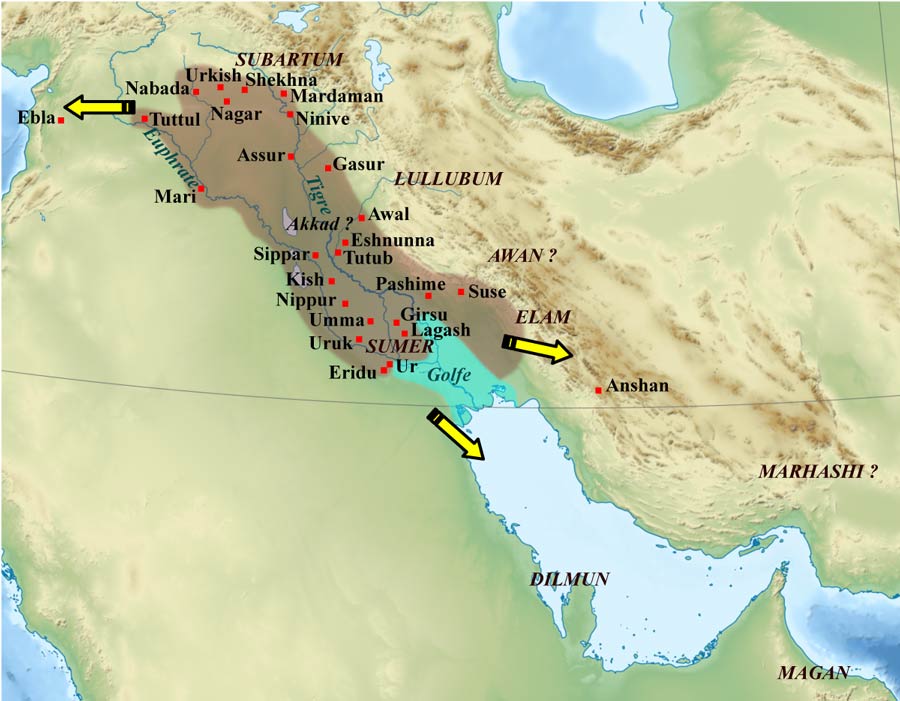
Map of the Akkadian Empire showing the extent of Mesopotamian control during the third millennium BC, when the Hurrians first appear in historical records. Reference: Wikimedia Commons (Public Domain)
When the veil that covers the dark ages of pre-historic Mesopotamia finally lifted during the third millennium BC when the earliest written records appear, we discover the existence of three different peoples who lived in ancient Mesopotamia and played a crucial role in the formation of that ancient land. They are the enigmatic Sumerians, the Akkadians, who were an eastern Semitic people that lived among the Sumerians, and the Hurrians, who inhabited regions further to the north. Even though other peoples like the Assyrians, Amorites (Babylonians) and Elamites also played an important role in Mesopotamian history later on, these peoples were the founders of Mesopotamian civilisation.
Scholars are not at all sure when the Hurrians first came to inhabit the northern regions of Mesopotamia. Some have postulated a “massive migration of Hurrian speaking peoples” into the northern parts of Mesopotamia during early Akkadian times, perhaps even earlier. Excavations at Urkesh (Tell Morzan), a Hurrian capital city located in the Upper Khabur Region in northeastern Syria, show continuous settlement from about 2700 BC. The Hurrians became known as fierce warriors, formidable archers, excellent smiths and great poets and storytellers who created magnificent cycles of legendary and mythic tales.

Like this Preview and want to read on? You can! JOIN US THERE ( with easy, instant access ) and see what you’re missing!! All Premium articles are available in full, with immediate access.
Top Image: Epic scene depicting the Hurrians in their mountainous homeland, combining historical and mythological elements including warriors, giants, and dragons that feature prominently in ancient Mesopotamian literature and the traditions about giants.( Generated using Flux-Pro/Kontext/Pro AI model)




![The Great Pyramid Of Giza Top image: The Great Pyramid of Giza under a starlit sky, highlighting the North Face. Source: [Pixabay/Creative Commons] Image](/sites/default/files/styles/article_popular/public/field/image/Great%20Pyramid%20Of%20Giza_0.jpg?itok=EjAqNQlu)


