



Ever since mummy KV55 was discovered in 1907, it has generated deep interest, debate, and controversy. The big issues have been identifying the KV55 mummy in ancient Egyptian history and combining its most probable identity with that person’s proposed age of death.
Could mummy KV55 really be the ‘heretic pharaoh’ Akhenaten, as many scholars believe? If so, a team of scientists at the Forensic Anthropology, Paleopathology and Bioarchaeology (FAPAB) Research Center in Sicily, Italy, have finally revealed the image of this famous pharaoh - and it’s nothing like how he was portrayed in the ancient artwork!

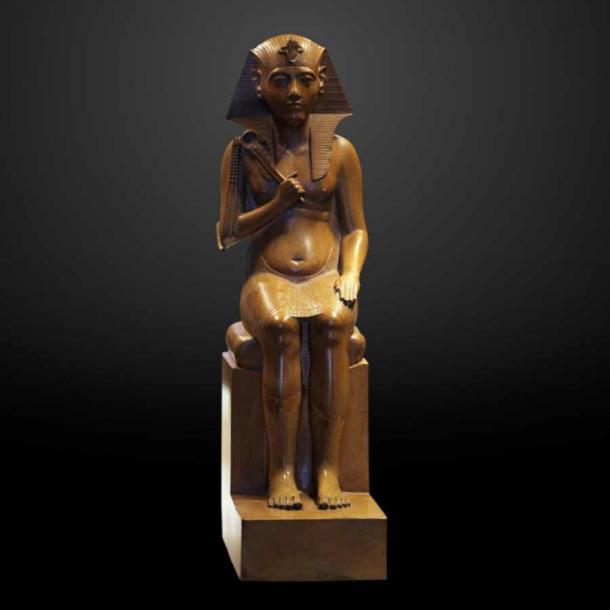
Statue of Akhenaton in the Louvre. (FAPAB Research Center)
Facts and Controversy Surrounding Mummy KV55
- The mummy was found with grave goods attributed to different people and a desecrated coffin in the undecorated tomb KV55 in the Valley of the Kings in 1907 by an Egyptologist named Edward R. Ayrton.
- This tomb is just a few meters from Tutankhamun’s tomb.
- Upon excavation, mummy KV55 disintegrated into dust and bones, so today it’s only a skeleton.
- It was first suggested to be Queen Tyje (due to a broad pelvis), but Australian scientist Grafton E. Smith later declared the remains are male.
- Mummy KV55’s genetic results show this is the genetic father of Tutankhamun, however palaeomolecular experts criticized some of the results in 2010.
- Historical and archaeological research, including some artifacts in the tomb, suggest that mummy KV55 is Akhenaton (Akhenaten).
- Akhenaten (r. 1353–36/35 BC) is known as the ‘heretic pharaoh’ because he developed monotheism, worshipping the one ‘true’ god of Aten (the Sun disk). He was the son of Amenhotep III and the father of Tutankhamun.
- Historical evidence, which is fragmented and conflicting, suggests that Akhenaten died when he was about 40 years old. However mummy KV55 belongs to a man who is believed to have died in his early 20s.
- Some scholars argue that mummy KV55’s age of death demonstrate that this is actually an enigmatic Late Amarna period person named Smenkhkare.
An Exclusive Interview with Dr. Michael E. Habicht
FAPAB Director Francesco M. Galassi, a physician and palaeopathologist, and Egyptological studies coordinator Michael E. Habicht oversaw the creation of the new facial reconstruction of the KV55 mummy, which was completed by the well-known Brazilian expert Cicero Moraes, who has been recognized for his skilled facial reconstructions.
- A Pharaoh Thrice Buried? The Mystery of the Tombs of Pharaoh Akhenaten
- Game of Toes in Amarna: Missing Body Parts and Funerary Practices of King and Commoner
Dr. Michael E. Habicht, who is also an Archaeologist, Egyptologist, and Senior Research Fellow at Flinders University, Australia, told us about the new facial reconstruction and the research team’s perspectives on the mysteries surrounding mummy KV55.
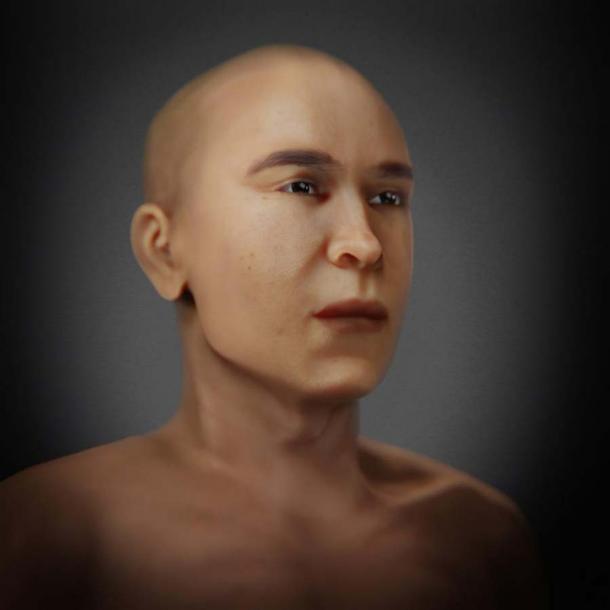
Side view of the facial reconstruction of Mummy KV55. (FAPAB Research Center)
Interview
Alicia McDermott: Please describe the process used to create this facial reconstruction.
Dr. Michael E. Habicht: Based on published data and images from various studies, a three-dimensional skull model of KV 55 was created. This was then checked again against the images.
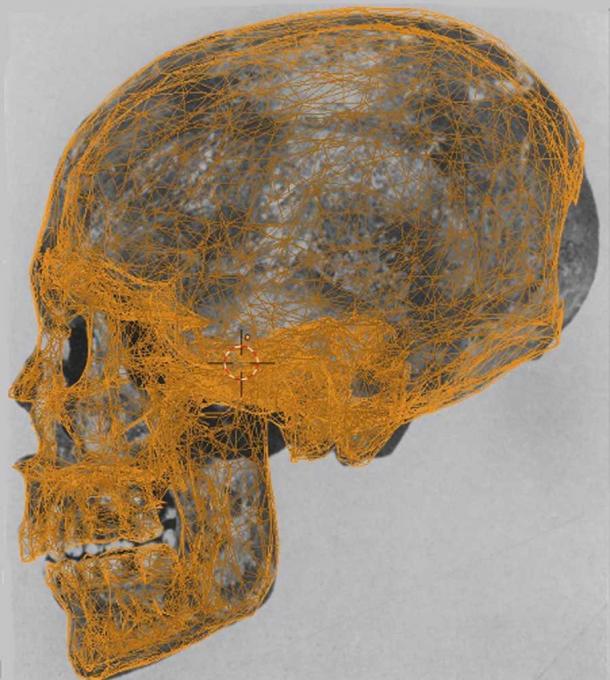
Mummy KV55’s skull with data points used in the facial reconstruction. (FAPAB Research Center)
Facial muscles, eyes, fat pads and skin are now modelled on this digital skull model using the so-called Manchester method. The tissue thickness is determined for numerous anatomical points based on forensic mean values.
The skin, eyes and shape of the ears are approximations based on the fact that this is an Egyptian, which accounts for brown eyes and a skin complexion that is still common in Egypt today.
AM: How does this facial reconstruction balance forensic art with anatomical and anthropological information?
MH: The facial reconstruction was blindfolded: Cicero Moraes, our expert for face reconstruction, only received the skull data and the information that it was a man from Egypt, and not older than 25 years. Therefore, this reconstruction has no Egyptian crowns or royal jewelry to distort the impression. Therefore, we think that our reconstruction is as objective as possible and follows purely scientific methods.
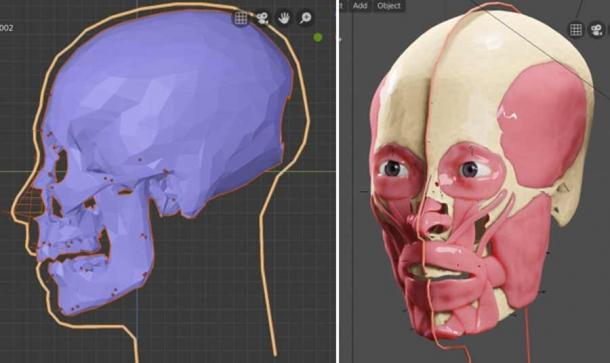
Steps in the facial reconstruction process. (FAPAB Research Center)
AM: There is a lot of controversy surrounding the skin color of ancient Egyptians, could you please tell us how you made the choice of skin color for this reconstruction?
MH: It is indeed a highly debated topic but it should be assessed with an open mind, pushing away the racist connotations that have characterized this debate in the past. We decided to use skin tone IV (in the Fitzpatrick scale of I-VI) which is typically encountered in Egypt and in the Mediterranean, an olive completion. Based on the available evidence it would be unrealistic to opt for a much lighter or much darker skin tone. Eventually, a new genetic analysis of KV55’s remains would add more evidence.
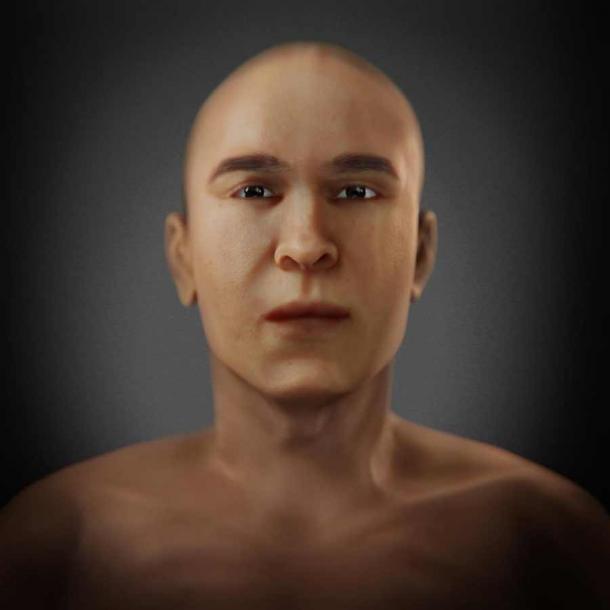
The facial reconstruction of mummy KV55. (FAPAB Research Center)
AM: Why has it been so difficult to pinpoint an age of death for this mummy?
MH: It wasn’t particularly difficult, to be honest, as the comprehensive study by the late anthropologist Eugen Strouhal demonstrated. It required an objective evaluation using all available skeletal districts and a consultation of the recent anthropological literature.
The main problem was the a priori identification with Akhenaton plus the assumed age at death of the heretic pharaoh (about 30 years old or older). This has represented the main problem, but by objectively assessing the skeleton and published literature it appears clear that it belongs to a younger individual between the end of adolescence and early adulthood, 19-22 years).
The heretic pharaoh Akhenaten. (FAPAB Research Center)
AM: With so much controversy surrounding the mummy’s identification, who do you think is the best candidate? Is it Tutankhamun’s father Akhenaten? If so, how does that information fit with the belief that his death occurred when he was around 40 years of age and this mummy being younger? Or could the mummy be the remains of the enigmatic figure called Smenkhkare, as some scholars have proposed?
MH: It is most reasonable to assume that Akhenaton and Nefertiti are the historical parents of Tutankhamun, due to historic inscriptions. If one accepts the genetic study from 2010, KV 55 shall be the father and the younger lady KV 35 is the genetic mother of Tutankhamun.
Historical records testify 17 years of reign by Akhenaton. It is debated if some of the first years might be a co-regency with his father Amenhotep III. We acknowledge that an age of 22 years and 17 years of reign would make Akhenaton very young at the time of accession.
It would hardly be arguable that Akhenaten could be the real father of the eldest daughters (Meritaton, Maketaton and possibly also Anchesenamun). The mummies of these daughters have not yet been identified, so Amenhotep III could also be the father (contrary to inscriptional propaganda). Since Tutankhamun was only born in the 12th year of Akhenaten, it is still possible that Akhenaten was the real father, even if he was very young.
If Smenkhkare is assumed to be the father of Tutankhamun, this is also problematic. There is no certain historical evidence that Smenkhkare was a younger brother of Akhenaten.
Moreover, many experts argue that Smenkhkare is in fact the fictitious figure that Queen Nefertiti assumed at the end of Akhenaten's reign to succeed him as male king (analogous to Hatshepsut, who ruled as King Maat-Ka-Ra).
- The Mystery of Egyptian Tomb KV55 in the Valley of the Kings
- Egyptologists Set to Unravel the Identity of Mystery Pharaoh from Tomb KV55

A relief of a royal couple in the Amarna style; figures have variously been attributed as Akhenaten and Nefertiti, Smenkhkare and Meritaten, or Tutankhamen and Ankhesenamun. (Public Domain)
AM: If this is Akhenaton, why does he look so different from the ancient representations of the ‘heretic pharaoh?’ Could it be due to the style of art that was used by artists in the Amarna period?
MH: Egyptian art is generally not very realistic, but reflects a desired ideal image, especially in the case of the king. In the Amarna period, a grotesque, almost comic-like sense of art was introduced. In the course of time, art became more moderate and elegant again (the famous Berlin bust of Nefertiti is in this later tradition). It is therefore not surprising that the family members of the royal family of Amarna look normal and not like in Amarna art.

Broken colossal statue of Akhenaten in the Amarna art style. (FAPAB Research Center)
The research team is currently finishing work on a full-length anthropological report of their study of mummy KV55 and their facial reconstruction. It will be published in a peer-reviewed international journal.
Top Image: New facial reconstruction of the KV55 mummy. Source: FAPAB Research Center
By Alicia McDermott




Best thing to do is to report
Permalink
In reply to Note to the editor of this by Archaeologist
Best thing to do is to report him and then ignore him. He is looking for attention
Hi Bruce Nowakowski, YOU
Permalink
In reply to Best thing to do is to report by Bruce Nowakowski
Hi Bruce Nowakowski, YOU REALLY HAVE NOTHING TO REPORT HERE SINCE MY POST IS BASED ON MY HIGHLY EDUCATED OPINION BASED ON SEVERAL YEARS OF RESEARCH AND OBSERVATION INTO ANCIENT AFRICAN EGYPTIAN/NUBIAN CIVILIZATION. IT APPEARS THAT YOU AND I HAVE VASTLY DIFFERENT OPINIONS CONCERNING THE ANCIENT BLACK PHARAOH AKHENATEN WHO IS REPORTED TO HAVE BEEN THE FATHER OF BLACK BOY PHARAOH BY THE NAME OF TUTANKAMON. IF YOU CANNOT CONTROL YOUR EMOTIONAL OUTBURSTS SIMPLY BECAUSE YOU CANNOT CONTROL A BLACK SCHOLARLY OPINION BASED ON HISTORICAL FACTS, THEN YOU SHOULD BE INSIDE A WHITE SUPREMACIST CLASSROOM THAT WILL FILL YOUR MIND WITH COMMENTS THAT YOU WOULD LIKE TO BE TRUE, SO THAT YOU CAN FEEL THAT BLACK PEOPLE WERE NOT EGYPTIAN PHARAOHS, AND THAT ALL THE PHARAOHS HAD “RAZOR THIN TOP & BOTTOM LIPS, NARROW NOSES THE SIZE OF TWO LEAD PENCILS, AND STRAIGHT BLOND HAIR , THEN YOU CAN CONTINUE WITH THOSE BELIEFS AND I PROMISE THAT I WILL NOT REPORT YOU, OKAY. BUT I PROMISE YOU THAT YOUR WHITE SUPREMACIST BELIEFS WILL NEVER UPSET ME THE LEAST, BECAUSE I KNOW THAT WHATEVER YOU BELIEVE, IT WILL NOT CHANGE THE ANCIENT BLACK EGYPTIAN HISTORICAL EVENTS THAT OCCURRED EVEN BEFORE BLACK KING NARMER UNIFIED BOTH UPPER AND LOWER EGYPT MORE THAN 5,000 YRS AGO BEFORE THERE WAS AN ANCIENT BLACK MINOAN CIVILIZATION FOUNDED ON THE GREEK ISLAND OF CRETE, TO BECOME THE VERY FIRST CIVILIZATION IN ALL OF EUROPA. NOW YOU CAN REPORT MY EDUCATED BELIEFS.. Charles Bowles, AA, BA, MA (CSULB) Suma Cum Laude
Dear Charles,
Permalink
In reply to Hi Bruce Nowakowski, YOU by Charles Bowles
Dear Charles,
Glad you attended and perhaps even graduated fromThe Beach. Objectively, you would not have been considered for attendance to one of your world renowned neighboring schools such as USC or UCLA with acceptance rates less than 1/3 that of Long Beach State. So your supposed suma cum laude would highly unlikely even register anywhere but basically unimpressive. Please stop trying to appropriate Egyptian culture with zero ties to your West African heritage. There simply are no ties between Sub Saharan/West African and ancient Egyptian cultures historically, ethnically nor linguistically other than geography. Egyptian civilization is bereft of primitive tribalism(ie, gangs, clans, and warring tribes) found in great abundance outside the boundaries of ancient Egypt. One nation, one people throughout many unified cities under one rule.
Fight On✌️ USC grad(Dual BS degrees in Biological Sciences and Chemistry, Doctor of Pharmaceutical Sciences)
Hi Senowsret
Permalink
You must be from the southern California area since you understood that my alma mata (CSULB) is located in Long Beach, and the fact that you are aware that such schools as USC and UCLA are in the close vicinity, SO I APPLAUD YOU FOR HAVING THAT KNOWLEDGE CONCERNING THOSE SCHOOLS. HOWEVER, YOUR STATEMENT ABOUT THE PRIVATE SCHOOL OF “USC” BEING BETTER THAN CSULB IS QUITE ABSURD, AND IT SHOWED ME THAT YOU DON’T HAVE ANY REAL CONCRETE KNOWLEDGE ABOUT HOW ACCEPTANCE WORKS AT USC, HA HA HA? FIRST OF ALL,MOST DEGREES ARE HIGHLY PAID FOR BY WEALTHY PARENTS IN ORDER TO GUARANTEE GRADUATION FOR THEIR SPOILED “DUMB CHILDREN”. I GUESS THAT YOU HAVEN’T HEARD ABOUT THE TV ACTRESS AND OTHER WEALTHY WHITE PARENTS WHO PAID AND DONATED MONEY TO “USC” JUST TO HAVE THEIR DUMB CHILDREN ADMITTED AS STUDENTS WHO DID NOT QUALIFY FOR ADMISSION HA HA HA? ONE OF THE WEALTHY PARENTS WAS RELEASED FROM JAIL TIME ONLY RECENTLY FOR HER PART IN THESE SHAMEFUL UNFAIR ENROLLMENT SCAMS. IT IS A FACT THAT CALIFORNIA PUBLIC UNIVERSITIES SUCH AS UCLA, CSULB, CSUF(FULLERTON), AS WELL AS UCI (IRVINE) WHERE I WAS ACCEPTED TO STUDY MY PhD IN “COMPARATIVE CULTURES” IN THE SOCIAL SCIENCE DEPARTMENT ARE BY FAR THE MOST COMPETITIVE AND DIFFICULT PROGRAMS TO BE ACCEPTED. EVERYONE KNOWS THAT IF A STUDENT HAS THE MONEY, THAT THEY CAN EASILY ENROLL AT THE VERY EXPENSIVE PRIVATELY FUNDED UNIVERSITIES IN MY AREA SUCH AS USC, PEPPERDINE, LOYOLA MARYMOUNT ETC, BECAUSE THOSE DEGREES ARE “BOUGHT” AND NOT ACADEMICALLY EARNED, AS THEY WOULD BE AT CSULB, UCLA, UCI, UC BERKELEY, UC DAVIS AND ALL OF THE REST OF THE CALIFORNIA PUBLIC UNIVERSITIES WHERE STUDENTS HAVE TO EARN THEIR ACCEPTANCE, AND NOT PAY FOR IT UNDER THE TABLE HA HA HA? SO YES, I AM VERY PROUD OF MY SEVERAL DEGREES WHICH I EARNED AT CSULB WITH SOME OF THE BEST RENOWN PROFESSORS IN THE USA. I GUESS THAT YOU HAVE NEVER HEARD OF DR. MAULANA KARENGA (FOUNDER OF KWANZAA) WHO HAS WRITTEN MANY INTERNATIONAL BOOKS, AND HISTORICAL ARTICLES, AND WAS THE CHAIRMAN OF THE “AFRICANA STUDIES” DEPARTMENT AT THE SCHOOL DURING THE COMPLETION OF MY MASTERS DEGREE IN THE SOCIOLOGY DEPARTMENT WHICH WAS WHITE RACIST AS HELL, EVEN AMONG THE 1/3RD MARXIST INSTRUCTORS WHO APPEARED TO TO BE THE LEAST RACIST? ALSO, I NEVER TRIED TO TIE ANCIENT BLACK EGYPTIAN CIVILIZATION TO ANCIENT WEST AFRICAN BLACK CIVILIZATION HA HA HA?. IT IS IMPOSSIBLE TO COMPARE BLACK EGYPTIAN PHARAOHS SUCH AS KING AKHENATEN, TUT, THUTMOSIS, RAMSES, SENURET III, NEFERTITI, TO THE BLACK WEST AFRICAN KINGS/QUEENS SUCH AS SUNDIETA KEITA, SUNNI ALI BER, ASKIA MUHAMMAD, MANSA MUSA (MALIAN EMPIRE) WHO IS TODAY LISTED BY LEADING FINANCIAL EXPERTS TO BE THE RICHEST MAN EVER TO WALK GODS EARTH WITH AN ESTIMATED NET WORTH OF MORE THAN $600 BILLION USD (BASED ON PRESENT DAY STANDARDS). ALSO, THAT WEST AFRICAN EMPIRE (MALI) HAS BEEN DOCUMENTED TO HAVE BEEN THE SECOND LARGEST LAND EMPIRE IN THE WORLD, ONLY SECOND TO THE MONGOL EMPIRE OF GHENGISS KHAN HA HA HA? WHILE THE WEST AFRICAN EMPIRES CITIES SUCH AS “TIMBUKTU & SANKORE” MIGHT NOT HAVE BUILT GLORIOUS PYRAMIDS SAME AS THEIR BLACK EGYPTIAN BROTHERS, THEY DID INDEED BUILD AND CREATE VAST UNIVERSITIES OF HIGHER LEARNING WHERE STUDENTS/SCHOLARS CAME FROM MANY PARTS OF THE WORLD TO STUDY BEFORE THE LAST OF THE GREAT WEST AFRICAN EMPIRES OF GHANA, MALI, AND SONGHAI WAS EVENTUALLY DESTROYED BY THE MOROCCANS UNDER A BLACK AFRICAN SULTAN BY THE NAME OF MULAI ISHMAEL.. I AM SURE THAT YOU PROBABLY NEVER HEARD OF THE BLACK MOROCCAN SULTAN DURING THE 1600’S, AND PROBABLY BELIEVE THAT MOROCCANS WERE ALSO WHITE SCANDINAVIANS OR FROM SAUDI ARABIA HA HA HA? LATER
Sir Charles,
Permalink
In reply to Hi Senowsret by Charles Bowles
Sir Charles,
Unlike you or other Afrocentric racists trying to appropriate my cultural heritage, I'm Coptic. Perhaps you've heard of a great Copt:
The Verdict of Champollion on the Coptic Language:
Jean-François Champollion (1790 – 1832) deciphered the Egyptian hieroglyphs in 1822, and made it possible for modern Egyptology to emerge. He perhaps would not have been able to do that at all had he not studied Coptic first. There is one man, who is still largely enigmatic, who helped him to learn Coptic – Yuhanna Chiftichi, a Coptic priest who worked with the French during the French Campaign in Egypt (1798 – 1801), and left with the French, with many other Copts, to France when the French withdrew.[1] In France, he became priest at the church of Saint-Roch on Rue Saint-Honoré, in Paris. There, he assisted the Egyptian Commission in producing Description de l’Ėgypte; but, perhaps, his lasting service to civilisation was his assistance he gave to Champollion, who befriended him, to learn Coptic.
Champollion knew many European and Oriental languages, at least sixteen in total, including Latin, Greek, French, English, German, Arabic, Syriac, Chaldean (Aramaic), Sanskrit, Persian, and Chinese. When he became fluent in Coptic, he wrote in 1809:
I have thrown myself into Coptic, I want to know Egyptian as well as I know French, because my great work on the Egyptian papyrus [hieroglyphics] will be based on this language. . . . My Coptic is moving along, and I find in it the greatest joy, because you have to think: to speak the language of my dear Amenhotep, Seth, Ramses, Thuthmos, is no small thing. . . . As for Coptic, I do nothing else. I dream in Coptic. I do nothing but that, I dream only in Coptic, in Egyptian. . . . I am so Coptic, that for fun, I translate into Coptic everything that comes into my head. I speak Coptic all alone to myself (since no one else can understand me). This is the real way for me to put my pure Egyptian into my head. . . . In my view, Coptic is the most perfect, most rational language known.[2]
“Coptic is the most perfect and the most rational language known.”
This is the verdict of Champollion on the Coptic language. Those who know Coptic would tend to agree with him. And the Copts must know this, and be sure of the many beauties of their language.
________________
[1] For more on Yuhanna Chiftichi, see: Chiftichi, Yuhanna (CE:519a-520b) by Anouar Louca in Coptic Encyclopedia, ed. Aziz Suryal Atiya (New York, Macmillan, 1991).
[2] Muriel Mirak Weissbach, Jean François Champollion And the True Story of Egypt in 21st Century Science & Technology magazine, Winter 1999-2000, 12 (4), 26–39, p. 32. See also, Andrew Robinson, Cracking the Egyptian Code, The Revolutionary Life of Jean-Francois Champollion (London, Thames & Hudson, 2012), p. 61.