


Ancient tooth enamel from China has opened a rare molecular window onto one of the murkiest chapters in human evolution. A new Nature study reports that proteins preserved in 400,000-year-old Homo erectus teeth carry a signal also seen in Denisovans, raising the possibility that these two ancient human relatives once met and mixed in East Asia.
Protein Clues from Ancient Teeth
The research team, led by Qiaomei Fu of the Institute of Vertebrate Paleontology and Paleoanthropology in Beijing, analysed enamel proteins from six Middle Pleistocene Homo erectus individuals from Zhoukoudian, Hexian, and Sunjiadong in China. As The Independent noted in its report on the find, the sampled teeth belonged to five males and one female, giving researchers a rare biological glimpse of a species whose DNA is usually too degraded to study.
Instead of relying on DNA, the scientists used mass spectrometry to recover fragments of enamel proteins. In one tooth-enamel protein, ameloblastin, all six individuals shared two unusual amino-acid variants. One, AMBN(A253G), has not been found in Neanderthals, Denisovans, modern humans, Homo antecessor, or the older Homo erectus specimen from Dmanisi in Georgia.
- The Tragic Story of the Peking Man Site at Zhoukoudian
- Peking Man and China's Paleontological Nationalism
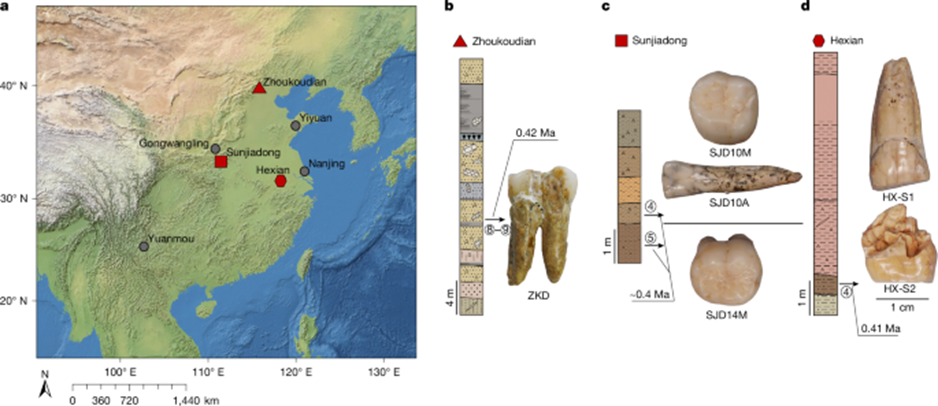
The geographic locations and samples of the Middle Pleistocene Homo erectus sites used in the study. (Image Source: Fu et al., Nature / CC BY-NC-ND 4.0)
A Denisovan Connection Emerges
The second variant, AMBN(M273V), is the more provocative clue. It has previously been identified in Denisovans, including a specimen from Denisova Cave and another from near Taiwan, according to Nature’s news coverage. The new study argues that this variant may have moved from populations related to East Asian Homo erectus into Denisovans through interbreeding, or through a closely ancestral population.
That makes the latest Homo erectus teeth analysis more than a technical achievement. It hints that the dense web of archaic human encounters may have reached deeper into time than the better-known mixing between modern humans, Neanderthals, and Denisovans. Some Denisovan DNA later entered modern human populations, so the protein trail may connect Homo erectus indirectly to living people.
“This traces who we are now back to our ancestors in a really cool and exciting way, using new methods,” Smithsonian paleoanthropologist Ryan McRae, who was not involved in the study, told The Independent. Fu also cautioned that “we really need to get more DNA” and more H. erectus remains to clarify exactly how this ancient population fits into the wider human family tree.
- Modern Humans Interbred With At Least Five Archaic Human Groups
- Modern Humans Could Have Mated With Denisovans as Recently as 15,000 Years Ago
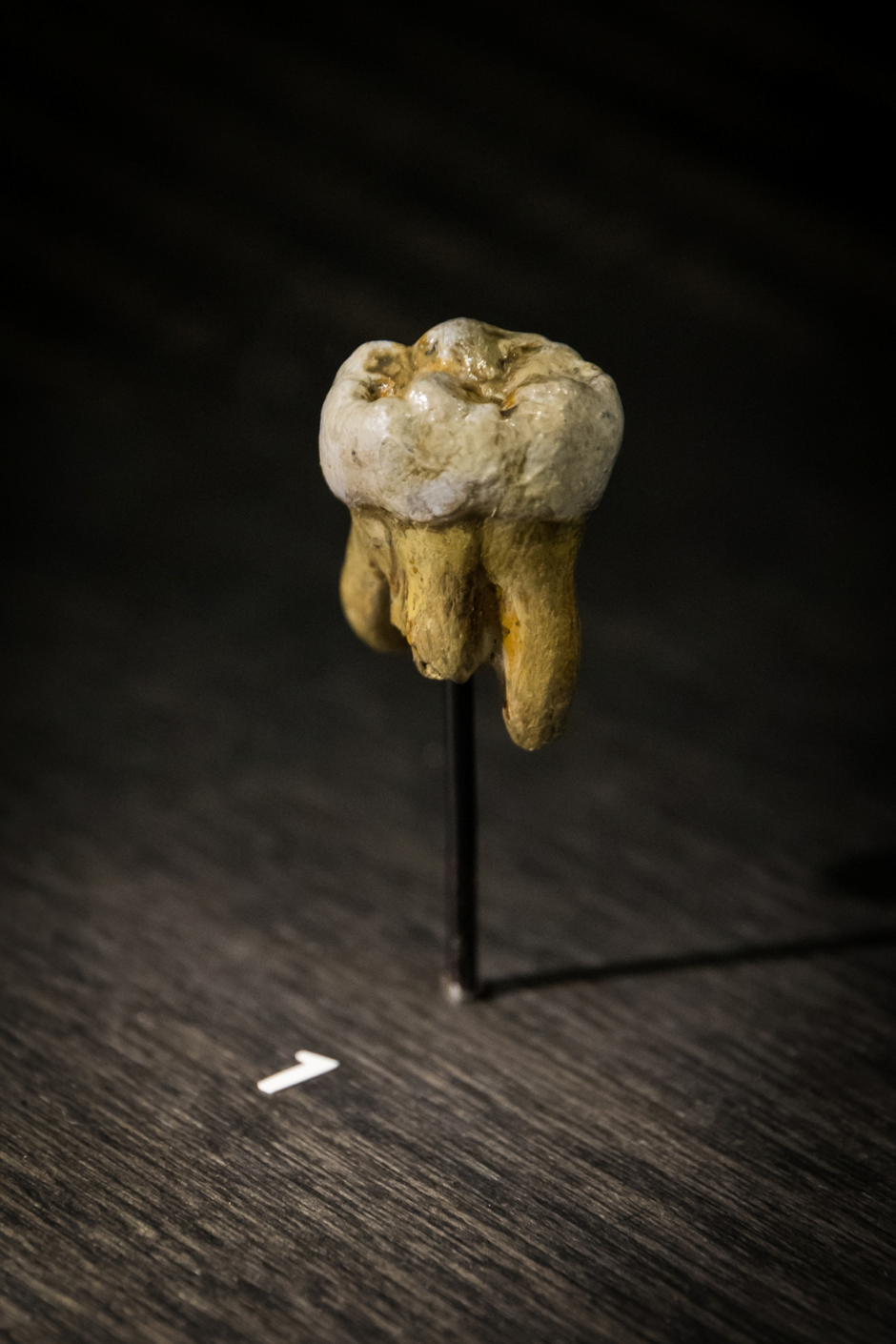
Replica of a Denisovan molar from Denisova Cave. (Image Source: Thilo Parg / Wikimedia Commons / CC BY-SA 3.0)
Zhoukoudian’s Long Shadow
Zhoukoudian, famous for the “Peking Man” discoveries of the 1920s and 1930s, has long been central to debates over Asian Homo erectus. The new study includes a Zhoukoudian tooth from layers dated to about 420,000 years ago, while the other specimens come from Hexian in Anhui Province and Sunjiadong in Henan Province, both around 400,000 years old.
The findings also revive questions about what happened in East Asia as older human forms overlapped with later groups. Ancient Origins has previously explored Zhoukoudian’s place in the story of Peking Man, while other work on Denisovan DNA has shown how much of this extinct population remains known only through genetic traces.
A Puzzle, Not a Final Answer
For now, the discovery does not prove a simple romance between Homo erectus and Denisovans. The shared protein variant could reflect direct mating, ancestry from a related population, or a more complicated pattern of “ghost” lineages that have not yet been found in the fossil record.
Still, the message from these Homo erectus teeth is clear: ancient East Asia was not a quiet evolutionary backwater. It was a living crossroads where long-lived human relatives may have exchanged genes, proteins, and biological legacies that echo into the present.
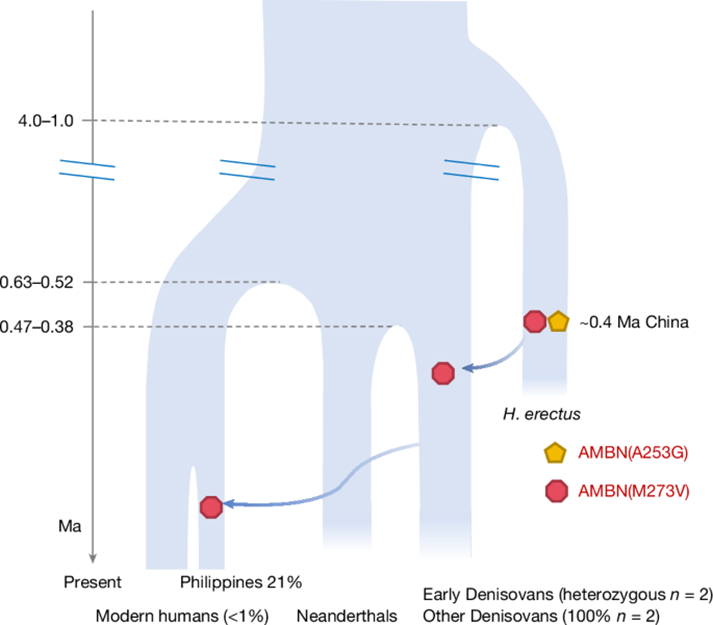
Possible model of gene flow related to AMBN(M273V) among Homo erectus associated with Zhoukoudian, Hexian and Sunjiadong, Denisovans and modern humans. (Image Source: Fu et al., Nature / CC BY-NC-ND 4.0)
Top image: Zhoukoudian Peking Man Site, China. Source: Mutt / Wikimedia Commons / CC BY-SA 4.0
References
Fu, Q. 2026. Enamel proteins from six Homo erectus specimens across China. Nature. Available at: https://www.nature.com/articles/s41586-026-10478-8
Lewis, D. 2026. Did Homo erectus and Denisovans mate? Tooth proteins hint at ancient trysts. Available at: https://www.nature.com/articles/d41586-026-01532-6
Ramakrishnan, A. 2026. Ancient 400,000-year-old teeth reveal early humans mated with ancestor Homo erectus. Available at: https://www.independent.co.uk/news/science/archaeology/homo-erectus-ancient-teeth-denisovans-b2975956.html