


In a remarkable archaeological find that challenges our understanding of medieval weaponry, researchers in Russia’s Astrakhan region have unearthed an exceptionally large saber in a 13th-century male burial. The discovery, made at the “Eagle’s Nest” settlement and burial ground, features a weapon that measures an astonishing 112 centimeters (almost four feet) long while still in its wooden scabbard. This finding is now being hailed as one of the most significant recent additions to the Astrakhan Museum-Reserve, offering new insights into the turbulent era of the Golden Horde and the elite warriors of the lower Volga.
The Orlinoye Gnezdo, or “Eagle’s Nest,” site in the Krasnoyarsky District has been a focal point for archaeologists studying the medieval period. During recent excavations, specialists from the “Nasledie” scientific and production institution examined a small rise where they identified over 50 Muslim burials. Most of these graves contained no artifacts, but two distinct burials stood out, revealing unusual practices and extraordinary grave goods.
- Saber Sword Found in Kyrgyzstan is a Medieval Marvel!
- Elite Avar Warrior Tomb Excavation Unearths Rare Treasures
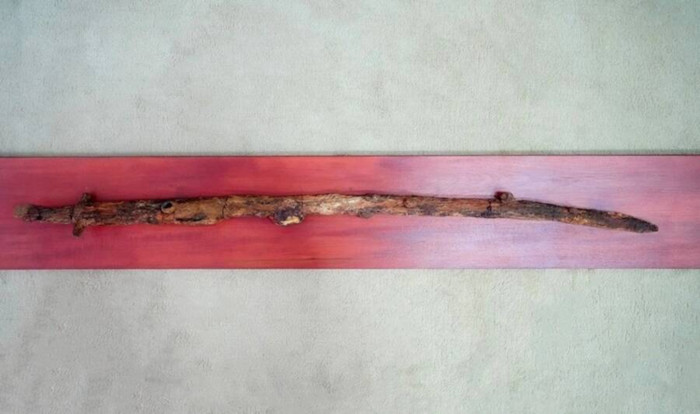
The 4-foot long saber sword discovered at Astrakhan in Russia. (Astrakhan Museum-Reserve)
The first of these unique graves, burial No. 52, contained the remains of a man placed face down with his head to the west. Archaeologist Tatyana Grechkina noted that his hands appeared to have been bound, and his skull indicated severe trauma to the neck. However, the presence of horse leg bones, a stirrup, and harness equipment nearby suggests this was not a simple execution but a complex burial practice with symbolic meaning.
Just below this grave, archaeologists discovered burial No. 53, which held the true treasure of the site. This mid-13th-century oval pit contained a male skeleton with traces of what may have been leather armor and a helmet. Alongside the body lay arrowheads and the giant saber, perfectly preserved within its wooden scabbard.
- The Golden Horde and the Mongol Mission to Conquer Europe
- Medieval Rus Warrior Burials Discovered in Russia
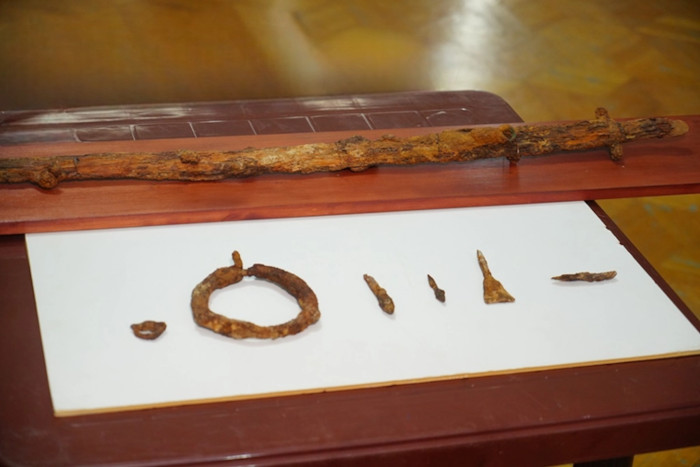
The saber with other artifacts found at the site. (Astrakhan Museum-Reserve)
A Weapon of Extreme Proportions
The saber’s remarkable preservation is a story in itself. Removed from the earth as a single 15-kilogram block, the weapon underwent four months of meticulous restoration. Restorer Mikhail Golovachev explained that the iron blade’s survival was largely due to its wooden scabbard, which was preserved through a chemical process involving iron oxides.
What makes the saber truly exceptional is its size. With a blade nearing one meter in length, it far exceeds the typical 70-centimeter sabers of the era. Golovachev suggests that such a weapon was not mass-produced but custom-made for a specific individual. Drawing a blade of this length would require a significant reach, implying the intended user was likely around two meters (six feet, five inches) tall.
Interestingly, the warrior buried with the saber stood only about 175 centimeters (five feet, nine inches) tall. This discrepancy raises intriguing questions about the weapon's purpose. Was it a ceremonial item, an inherited heirloom, or designed for a specialized fighting style? The discovery of what appears to be a birch-bark quiver and suspension elements nearby adds further context to how this impressive weapon was worn and utilized.
Unraveling the Mysteries of the Lower Volga
The 13th century was a period of profound transformation across the Eurasian steppe, heavily influenced by the rise and subsequent fragmentation of the Mongol Empire. The lower Volga region was a melting pot of cultures, where Islamic traditions, steppe warfare, and expansive trade networks intersected. The artifacts recovered from the Eagle’s Nest, including the saber, arrowheads, and tactics associated with horse harnesses, provide a tangible connection to this dynamic world.
Dmitry Vasilyev, a senior researcher at the Astrakhan Museum-Reserve, emphasized the importance of these finds in understanding the complex history of the region. The artifacts are currently being prepared for display, promising to shed more light on the status, warfare, and burial customs of the medieval Golden Horde.
As researchers continue to analyze these remarkable discoveries, the giant saber stands as a testament to the martial prowess and intricate societies of the 13th-century steppe. It not only challenges our preconceptions about medieval weaponry but also invites us to delve deeper into the enigmatic lives of the warriors who once roamed the lower Volga.
Top image: The medieval saber found in Astrakhan, Russia. Source: Astrakhan Museum-Reserve
By Gary Manners
References
Astrakhan Museum-Reserve. 2026. Коллекция Астраханского музея-заповедника пополнилась средневековой саблей экстремальной длины и редкой сохранности. Available at: https://astmuseum.ru/ru/news/kollektsiya-astrakhanskogo-muzeya-zapovednika-popolnilas-srednevekovoy-sabley-ekstremalnoy-dliny-i-r/
Fraga, K. 2026. Unusually Large Sabre Found In 13th-Century Grave In Russia. All That's Interesting. Available at: https://allthatsinteresting.com/astrakhan-russia-medieval-sabre
Kayra, O. 2026. Archaeologists Uncover a Giant Medieval Saber in a 13th-Century Warrior Grave Near Astrakhan. Arkeonews. Available at: https://arkeonews.net/archaeologists-uncover-a-giant-medieval-saber-in-a-13th-century-warrior-grave-near-astrakhan/